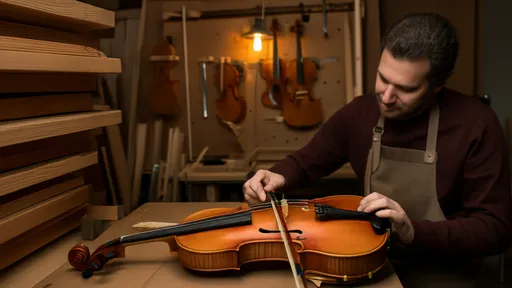
In the quiet corners of woodworking studios and music workshops, a growing number of artisans and musicians are rediscovering the art of crafting their own ocarinas. This ancient wind instrument, with its hauntingly pure tone, has captivated enthusiasts who seek not just to play music, but to create the very vessel from which it emerges. The journey from raw lumber to a finely tuned ocarina is both a science and an art, demanding patience, precision, and a deep understanding of acoustics.
The process begins long before any tools are wielded, with the critical selection of wood. Not all timber is created equal when it comes to instrument making. Hardwoods like maple, cherry, and blackwood are often favored for their density and fine grain, which contribute to the instrument's structural integrity and tonal quality. The wood must be properly seasoned, dried slowly over months or even years to prevent warping and cracking. Some craftsmen even seek out reclaimed wood from old furniture or barns, valuing its stability and character, each knot and grain pattern telling a story that will become part of the instrument's voice.
Once the perfect piece of wood is selected, the transformation begins. Using traditional hand tools or modern CNC machines, the block is carefully hollowed out to create the wind chamber. This cavity must be sculpted with mathematical precision, as its volume and shape directly determine the instrument's fundamental pitch and timbre. The walls are tapered to specific thicknesses—thick enough to produce a rich tone, yet thin enough to remain responsive. This stage requires constant measurement and testing, as even a millimeter's deviation can alter the sound dramatically.
The most delicate operation follows: cutting the sound hole and fashioning the fipple, or mouthpiece. This is where the magic happens—where breath becomes music. The edge of the sound hole, called the labium, must be razor-sharp and perfectly angled to split the air stream cleanly. The windway, the channel through which air travels to the labium, requires microscopic precision in its dimensions and smoothness. Any roughness or irregularity here will cause turbulent airflow, resulting in breathy, inconsistent tones rather than the pure, clear notes a well-made ocarina should produce.
With the body carved and the voice window established, attention turns to the finger holes. Their placement is not arbitrary but follows acoustic principles that have been refined over centuries. The size and position of each hole determines the pitch it will produce when uncovered. Craftsmen often use specialized calculators and templates based on the instrument's chamber volume, but ultimately rely on their ears during the fine-tuning process. This stage is iterative—drill, test, adjust—repeated until each note rings true across the ocarina's range.
The final shaping and sanding bring the instrument to life aesthetically. Hours are spent hand-sanding through progressively finer grits, from 120 to over 1000, until the surface feels like silk under the fingertips. The contours are refined, edges softened, and the entire instrument polished to highlight the natural beauty of the wood grain. This isn't merely cosmetic; a smooth interior surface improves airflow and tone quality, while comfortable ergonomics make the instrument a joy to play for hours on end.
Finishing presents another series of critical choices. Some makers prefer oil finishes that soak into the wood, enhancing its natural appearance while offering protection. Others use lacquers or varnishes that create a protective shell. Each option affects the sound slightly—oils tend to preserve the wood's natural resonance better, while hard finishes can make the tone slightly brighter. The debate over finishing methods is ongoing in the ocarina-making community, with passionate advocates on all sides.
Then comes the moment of truth: tuning. Using electronic tuners and their trained ears, makers test each note across the instrument's range. They listen for consistency of volume and timbre, checking for any notes that speak differently from their neighbors. If a note is flat, the corresponding hole may be carefully enlarged or undercut. If sharp, the solution is more complex—sometimes requiring filling and redrilling. This painstaking process separates adequate instruments from exceptional ones, as the maker coaxes the wood to sing precisely as intended.
Beyond the technical aspects, what makes a handmade ocarina special is the intangible connection between maker and material. The craftsman learns to read the wood, to understand its peculiarities and work with rather than against its natural properties. A slight density variation might suggest adjusting wall thickness here; an interesting grain pattern might inspire modifying the shape there. Each decision—from the initial wood selection to the final polishing compound—impacts the instrument's character.
The completed ocarina represents more than the sum of its measurements. It carries the maker's intention in every curve, the history of its materials in every note. When a musician brings it to their lips, they're not just playing an instrument—they're collaborating with the artisan who created it, joining their breath to the craftsman's vision. In an age of mass production, the handmade ocarina stands as a testament to the enduring human desire to create beauty through skill, patience, and direct engagement with natural materials.
This resurgence of interest in crafting ocarinas reflects broader cultural movements toward handmade goods, acoustic music, and mindful creating. Workshops are appearing where enthusiasts gather to learn the craft, online forums buzz with technical discussions, and a new generation of makers is adding innovations while respecting traditional methods. The ocarina, once considered a simple folk instrument, is being reimagined as a serious musical tool worthy of meticulous craftsmanship.
For those willing to undertake the journey, making an ocarina offers rewards beyond the instrument itself. The process cultivates patience, attention to detail, and a deeper appreciation for the physics of sound. It connects us to ancient traditions of instrument making while allowing for personal expression. Most importantly, it reminds us that some of life's greatest satisfactions come not from consuming, but from creating—from transforming raw materials into something that can literally make music.

By /Aug 22, 2025

By /Aug 22, 2025
By /Aug 22, 2025
By /Aug 22, 2025

By /Aug 22, 2025

By /Aug 22, 2025

By /Aug 22, 2025
By /Aug 22, 2025
By /Aug 22, 2025
By /Aug 22, 2025

By /Aug 22, 2025

By /Aug 22, 2025

By /Aug 22, 2025

By /Aug 22, 2025

By /Aug 22, 2025

By /Aug 22, 2025

By /Aug 22, 2025

By /Aug 22, 2025

By /Aug 22, 2025
By /Aug 22, 2025