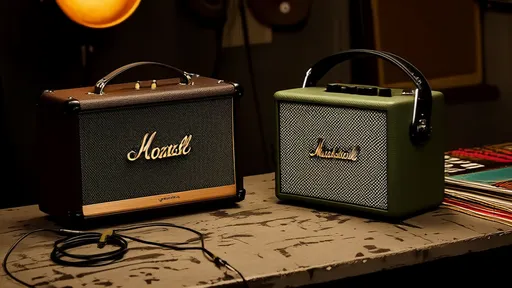
In the world of guitar amplification, few debates stir as much passion as the timeless clash between British and American tube tone. For decades, musicians have passionately defended their camps, but two names consistently rise to the top as the quintessential representatives of their respective continents' sonic philosophies: the iconic Marshall and the revered Fender, often affectionately personified as "Tweed" for its legendary Tweed-covered combos. This isn't merely a choice of equipment; it's a declaration of musical identity, a selection of the very voice through which a guitarist's hands and heart will speak.
The story begins in the smoky clubs of 1960s Britain, where a certain Jim Marshall, a drummer and teacher, noticed his students struggling to find powerful and affordable amplification. Teaming up with technician Ken Bran and a young, soon-to-be-legendary circuit designer named Dudley Craven, they sought to replicate the roar of American amplifiers but ended up creating something entirely new and uniquely British. Their now-legendary creation, the JTM45, was indeed based on the Fender Bassman circuit, but with crucial modifications—most notably, the replacement of American 5881 power tubes with the warmer, earlier-breaking British KT66s. This was the genesis of a sound that would define rock and roll for generations to come.
This British beast is characterized by its aggressive, mid-focused punch. When you think of Marshall, you think of that crunchy, assertive roar that cuts through any mix with authority. It’s the sound of a tight, complex harmonic distortion that blooms under the fingers, offering a singing sustain that feels both powerful and controlled. The classic Marshall voicing, often described as a "scooped" midrange is actually a misconception; it possesses a pronounced upper-midrange spike that gives it its incredible presence. This is the voice of arena rock. It’s the sound behind Pete Townshend's windmilling power chords with The Who, the blistering lead work of Jimi Hendrix at Woodstock (though an American, he wielded British stacks to forge his sound), the timeless riffing of Angus Young's Gibson SG, and the sheer, unadulterated power of Slash's Appetite for Destruction solos. It’s a sound built for volume, for attitude, and for commanding the attention of every person in a packed stadium.
Across the Atlantic, a different legend was being woven, one born in the sun-drenched studios of California and the dance halls of the American South. Leo Fender’s designs, particularly the late-1950s Tweed-covered amplifiers like the Bassman and the Deluxe, were not initially designed for the distorted roar that would later make them famous. They were built for clarity, warmth, and clean headroom to accommodate the country, blues, and swing musicians of the era. However, musicians soon discovered that when these amps were pushed to their limits, they produced a magical, organic overdrive that became the cornerstone of American rock and blues.
The character of a classic Tweed-style amp is the polar opposite of its British counterpart. Where the Marshall is sharp and commanding, the Tweed is round and forgiving. Its distortion is woolly, spongy, and deeply responsive to a player's touch and guitar volume knob. It compresses beautifully when driven, creating a sweet, singing sustain that feels less aggressive and more vocal. The tonal focus is less on a midrange punch and more on a sparkling, bell-like high-end and a robust, supportive low-end. This is the sound of bluesy articulation and rootsy grit. It’s the sound of Stevie Ray Vaughan’s searing, soulful Stratocaster, the warm crunch of Keith Richards’ open-G riffs on a Telecaster, the creamy lead tones of Eric Clapton’s "Woman Tone," and the raw, energetic spirit of early rock and roll. It’s an amp that feels like a responsive partner, reacting to every nuance of your playing.
Choosing between these two titans is less about selecting a "better" amplifier and more about understanding the musical language you wish to speak. The Marshall offers a powerful, refined, and modern distortion that is almost synonymous with the very idea of rock guitar. It provides a solid, consistent foundation for high-gain playing, tight rhythm work, and soaring leads that need to be heard at the back of a large venue. Its gain structure is more immediate and structured, making it a reliable workhorse for genres like hard rock, metal, and punk where a clear, cutting tone is paramount.
Conversely, the Tweed Fender philosophy offers a more organic and interactive experience. Its overdrive is earned through volume and playing dynamics, rewarding a lighter touch with crystal-clear cleans and a heavier hand with a complex, saturated crunch. This makes it incredibly versatile within the realms of blues, classic rock, country, and Americana. It’s the amp for the player who views their volume knob as an essential part of their tone-shaping toolkit, offering a vast spectrum of sounds from a single channel. However, its looser low-end and earlier onset of distortion can become flubby at extreme volumes or with high-output pickups, lacking the tight low-end control of a high-gain Marshall.
Ultimately, the "Tweed vs. Marshall" debate has no definitive winner because it is built on a false dichotomy. These amplifiers are not rivals; they are complementary pillars of the guitar tone pantheon. Many professional studios consider both essential tools, much like a painter values both a fine bristle brush and a broad palette knife. They are used for different colors and different strokes. Countless iconic records feature both: a Marshall might track the main riff for its cutting power, while a dimed Tweed Deluxe might layer a second track to add organic warmth and complex harmonics. The smart guitarist understands that this isn't a battle to be won, but a rich spectrum of tonal possibilities to be explored.
The pursuit of tone is a deeply personal journey, and the choice between these two classic sounds is a fundamental crossroads. It asks a player to listen not just with their ears, but with their hands and their heart. Do you seek the explosive, commanding roar that defined rock's arenas, or the soulful, responsive grind that fueled its blues-soaked roots? The answer lies not in a spec sheet, but in the music you feel compelled to make. The best advice is to spend time with both, turn them up loud, and let your guitar decide. The right amp won't just amplify your signal; it will amplify your voice.

By /Aug 22, 2025
By /Aug 22, 2025

By /Aug 22, 2025
By /Aug 22, 2025

By /Aug 22, 2025
By /Aug 22, 2025
By /Aug 22, 2025
By /Aug 22, 2025
By /Aug 22, 2025
By /Aug 22, 2025

By /Aug 22, 2025

By /Aug 22, 2025
By /Aug 22, 2025

By /Aug 22, 2025

By /Aug 22, 2025

By /Aug 22, 2025
By /Aug 22, 2025

By /Aug 22, 2025
By /Aug 22, 2025
By /Aug 22, 2025