In the world of hair accessories, few items have experienced such a dramatic resurgence as the shark clip. Once relegated to the back of bathroom drawers and nostalgic 90s fashion, these functional clasps have swum back into mainstream style with undeniable force. But beyond their aesthetic appeal lies a fascinating world of physics, material science, and mechanical engineering that makes these seemingly simple devices both effective and enduring. The humble shark clip represents a perfect marriage of form and function, where decorative appeal meets sophisticated physical principles.
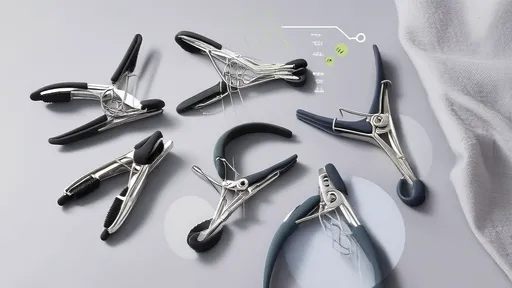
The fundamental physics behind shark clips begins with their namesake inspiration—the actual jaws of a shark. Much like how a shark's teeth are arranged in multiple rows that work in concert to grip prey, the teeth of a shark clip are designed to interlock with incredible precision. When pressure is applied to open the clip, the teeth separate against the tension of the metal spring, storing potential energy. Upon release, this energy converts to kinetic energy as the teeth snap back together, creating a secure grip on hair. The curvature of the clip's jaws follows principles of mechanical advantage, distributing pressure evenly along the length of hair to prevent slippage without causing damage.
Material selection plays a crucial role in the clip's performance. Most quality shark clips utilize stainless steel springs for their excellent elastic properties and corrosion resistance. The spring must maintain its modulus of elasticity through thousands of opening and closing cycles without suffering from metal fatigue. Meanwhile, the outer casing—typically made from durable plastics, resins, or metals—must provide sufficient structural integrity while remaining lightweight enough for comfortable wear. Advanced polymers in modern clips offer remarkable strength-to-weight ratios that earlier versions lacked.
The geometry of shark clips represents a triumph of functional design. The classic banana shape isn't merely aesthetic—it follows a specific curvature that maximizes surface area contact with hair while maintaining even pressure distribution. This curvature creates what engineers call a constant force mechanism, where the clamping force remains relatively consistent regardless of how much hair is secured within the clip. The teeth themselves are angled precisely to create a ratcheting effect that prevents backward slippage, much like the barbed design of fishing hooks or agricultural implements.
From a tribological perspective—the study of friction, wear, and lubrication—shark clips demonstrate sophisticated understanding of surface interactions. The teeth are designed to create optimal friction with hair shafts without causing excessive breakage. This involves careful consideration of tooth sharpness, spacing, and angling. Too much friction causes damage and discomfort, while insufficient friction leads to slippage. The best clips achieve what tribologists call the friction coefficient sweet spot, where hold security and hair health are balanced perfectly.
Thermodynamics also plays a role in shark clip performance. Temperature changes can affect both the metal spring's elasticity and the plastic components' dimensional stability. Quality clips are designed to maintain consistent performance across a range of environmental conditions, from humid summer days to dry winter interiors. The materials are selected for their low thermal expansion coefficients, ensuring that the clip's gripping force remains reliable whether worn at the beach or in a climate-controlled office.
The decorative aspects of shark clips—the colorful resins, pearlized finishes, and metallic coatings—involve their own scientific considerations. The adhesion of decorative elements to the underlying structure requires understanding of material compatibility and surface chemistry. UV-resistant coatings prevent fading from sun exposure, while scratch-resistant surfaces maintain appearance through daily use. The weight distribution of decorative elements must be balanced to prevent the clip from twisting or rotating during wear, maintaining both aesthetic appeal and functional integrity.
From a biomechanical perspective, shark clips interact with human hair in fascinating ways. Hair itself possesses complex physical properties—elasticity, tensile strength, and friction characteristics that vary with humidity, texture, and condition. The clip must accommodate these variables while providing consistent performance. The design allows for natural hair movement without complete release, providing security while avoiding the scalp tension that causes headaches—a common issue with traditional hair ties and many other accessories.
The manufacturing process of quality shark clips involves precision stamping, injection molding, and assembly techniques that ensure consistent performance. Spring tension is calibrated to specific tolerances, tooth alignment is maintained within microscopic margins, and surface finishes are applied with controlled thickness. This manufacturing precision transforms raw materials into devices that perform their intended function reliably through years of use—a testament to industrial engineering excellence.
Environmental factors have driven recent innovations in shark clip design. Many manufacturers now use recycled plastics and metals, requiring reformulation of material compositions to maintain performance standards. Biodegradable options are entering the market, presenting new engineering challenges in creating clips that maintain functionality throughout their usable life while breaking down efficiently after disposal. These sustainable versions represent the cutting edge of materials science applied to everyday objects.
The resurgence of shark clips in fashion has led to experimental designs that push physical boundaries. Oversized clips must distribute weight differently to prevent slippage, while miniature versions require even more precise spring mechanisms. Designers are experimenting with unconventional materials like carbon fiber and bamboo, each bringing unique physical properties that must be engineered into functional hair accessories. These innovations continue to expand our understanding of how simple mechanical principles can be adapted to human needs.
From an ergonomic perspective, the operation of shark clips involves sophisticated human-device interaction. The opening mechanism is designed to require sufficient force to prevent accidental release but minimal enough for easy operation. The tactile feedback—the satisfying click when the teeth engage—provides sensory confirmation of secure fastening. This haptic response is carefully engineered through spring tension and tooth design, creating an intuitive user experience that requires no visual confirmation to operate effectively.
The cultural journey of shark clips—from functional tool to fashion statement and back again—demonstrates how good design transcends trends. The underlying physics remains constant even as surfaces and styles evolve. This endurance testifies to the effectiveness of the basic mechanical principles employed. As fashion continues to rediscover and reinvent this accessory, the fundamental science ensures that form and function remain perfectly balanced.
In examining the shark clip through a scientific lens, we discover that everyday objects often contain hidden depths of engineering sophistication. What appears as a simple hair accessory actually represents centuries of accumulated knowledge in materials science, mechanical engineering, and human factors design. The next time you secure your hair with one of these devices, consider the complex physics at work—the stored energy in the spring, the precisely calculated friction of the teeth, the carefully balanced forces that keep everything in place. It's a miniature masterpiece of functional design, proving that sometimes the most ordinary objects contain extraordinary science.

By /Aug 21, 2025

By /Aug 21, 2025

By /Aug 21, 2025

By /Aug 21, 2025

By /Aug 21, 2025

By /Aug 21, 2025
By /Aug 21, 2025
By /Aug 21, 2025

By /Aug 21, 2025

By /Aug 21, 2025

By /Aug 21, 2025

By /Aug 21, 2025

By /Aug 21, 2025

By /Aug 21, 2025

By /Aug 21, 2025

By /Aug 21, 2025

By /Aug 21, 2025

By /Aug 21, 2025
By /Aug 21, 2025

By /Aug 21, 2025